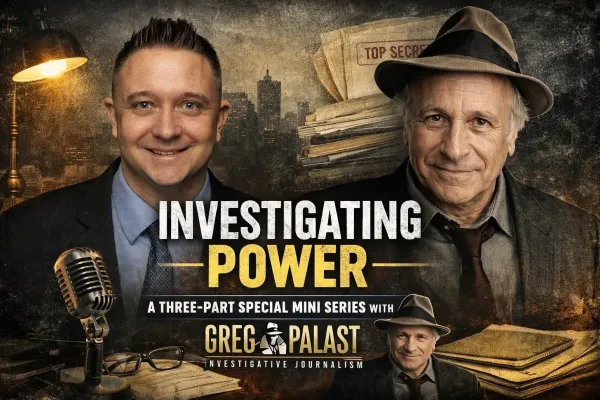
From Epstein and MI6 to voter suppression, coups, and the insiders who risk everything to expose them — Kevin Patrick interviews Greg Palast in this three-part special miniseries.
Over the course of more than an hour, investigative journalist Greg Palast spoke candidly about the world’s most powerful people we never get to see — a world of insiders, whistleblowers, secret networks, and the fragile systems that quietly determine the fate of governments, elections, and nations.
The conversation covers allegations involving high-level political figures, intelligence agencies, and the individuals who risk everything to expose what powerful institutions work hard to keep hidden. Palast shares firsthand accounts of undercover investigations, being arrested while reporting on a coup attempt in Kazakhstan, and what happens when journalism crosses paths with real power.
We talked about voter suppression, the systematic removal of tens of thousands of voters, and how entire populations can be quietly blocked from participating in democracy — not just in the past, but today.
Drawing on his reporting for the BBC, Rolling Stone, and The Guardian, as well as the real stories behind his film, Vigilantes Inc., Palast makes the case that the greatest threat to democracy is not what people see — but what they never hear about.
Some of what Palast shared was deeply unsettling. Some of it was surprising. And some of it explains far more about how power truly operates than most people realize.
This is not speculation. This is the perspective of someone who has spent his career following the money, confronting power, and exposing truths others were afraid to touch.
Video here: https://www.youtube.com/watch?v=TM7lMvrM0k4
Part I: What Happens When You Investigate Powerful People
Investigative journalism begins with a question. For Greg Palast, it began with a simple instinct: to look closer.
Part I traces how Palast became an investigative journalist and what it truly means to investigate power — the systems behind elections, institutions, and governments, and the discipline required to follow truth wherever it leads. Investigative journalism, in his telling, is not about speculation. It’s about observation, persistence, and evidence. Recognizing patterns others overlook. Asking questions others stop asking.
But as Palast makes clear, investigations don’t remain theoretical forever. Eventually, they become personal.
Part II: Undercover investigations. Secret police. Smoking guns.
This is where the stories turn global. Palast doesn’t just investigate from a desk. He goes undercover.
He’s been arrested by the secret police of Kazakhstan. He’s uncovered what he describes as the selling of British national secrets linked to Jeffrey Epstein. He’s traced alleged MI6 involvement in the overthrow of a foreign government. And he’s followed smoking guns that most reporters won’t go near.
This episode isn’t theory. It’s firsthand experience from someone who has operated inside the shadows of power and lived to tell the tale.
Part III: Vigilantes, Inc. and the modern battle over who gets to vote.
The final installment turns to Palast’s latest film, Vigilantes, Inc. — backed by Jamie Foxx, George DiCaprio, and Leonardo DiCaprio — and the question at its center: Who gets to vote… and who gets removed?
Palast lays out what he describes as a modern vigilante challenge system, one that mirrors historic suppression tactics updated for the digital age — with large-scale voter removals, targeted eligibility challenges, and claims that over 200,000 legal voters have been struck from the rolls, disproportionately impacting communities of color, young voters, college students, and women.
This episode isn’t about shouting. It’s about evidence.
And it closes this series with a simple but uncomfortable reality: If participation can be challenged at scale…Would you even know it happened?
Greg Palast Investigates is a reader-supported publication. To receive new posts and support our work, consider becoming a free or paid subscriber.